Tuesday, July 02, 2013

2013 Dirty Dozen


The Environmental Working Group (EWG) has updated their “Dirty Dozen” list of produce items that typically contain high levels of pesticides.  The current recommendation is that, if financially possible, you consider purchasing the Organic option of the following items:

-apples
-strawberries
-grapes
-celery
-peaches
-spinach
-sweet bell peppers
-nectarines
-cucumbers
-potatoes
-cherry tomatoes
-hot peppers


What does 200 calories look like??

Monday, June 10, 2013

Recent Positive Feedback


A mentor of mine once told me that a little unexpected positive self-affirmation is good for the soul.  That being said, I was very pleased this week to receive some great feedback from a couple of participants who were enrolled in my Weight Loss Boot Camp. The comments were as follows:


"Paul Connolly worked so well designing his exercise routine for the age group. It got increasingly more robust with each class which was great and helped several of us with foot/knee, etc. issues use substitute moves during the class. I loved the stretch cords we got and used throughout the class and at home! He answered all of our questions/concerns about exercise thoroughly and completely. Wonderful instructor! "   (-Newburyport, MA participant)

"I really enjoyed the class with Paul.  It was a pleasure to meet Paul.  He was really a delight. At his young age, Paul is great at making a group of women feel successful about any positive changes they can make in their lifestyle."   (-Bolton, MA participant)


Wednesday, May 15, 2013

Suggested Warm-up Routine


This is a great pre-workout mobility routine designed by my colleague, Tony Gentilcore.  Our colleague, Alli McKee, is the model demonstrating the exercises.


Great Lecture from Mark Bittman

Thursday, April 25, 2013

Reading, MA Weight Loss Boot Camp Success!


Great article here on some recent success I had in Reading, MA with their town employees:


Reading Employees Succeed with Weight Loss Boot Camp

         Pat Iapicca, a police officer with the Reading department for 30 years and married father of three, has lost a total of 35 pounds since he began participating in MIIA’s wellness programs five years ago. In 2008 he also completed Heart Matters, an 11-week multi-disciplinary program designed to promote cardiovascular health, and in 2010 he participated in New Directions in Weight Loss, which included components focusing on nutrition, weight loss, and relaxation through hypno-therapy.
“I love the common sense approach of all of these programs and the combination of nutrition with exercise in particular,” Iapicca said. “There is very little pressure, the approach makes sense and works out very well. Participating in something every year or so helps reinforce what works and keeps me on the straight and narrow.” Although his weight had inched up a few pounds over the last year, Iapicca noted that the recent Boot Camp helped him get back on track and down to his ideal weight.
During the Monday afternoon meetings, local participants learned to integrate both nutrition and exercise recommendations into their lifestyle to promote weight loss, improve cardiovascular fitness and increase strength. Program leaders, Sandy Sarni, a registered dietitian and MIIA’s Nutrition Specialist, and Paul Connolly, a certified exercise trainer, led the sessions – which focused on a variety of topics including goal setting, food tracking, portion control, smart snacking, and the relationship between activity level and weight loss. Participants spent half the time each week learning diet and nutrition tips, and the other half doing cardio and stretching exercises. Iapicca noted that Connolly was “really great” with showing group members how to get their heart rates up quickly and achieve the most exercise benefits in a short period of time and with suggesting ways to incorporate exercise into a busy lifestyle. “Sandy taught us proper eating habits and Paul taught us that it doesn’t have to be a three-hour workout every day,” he said. “Just incorporate walking, keep moving and keep track – it makes sense and works well.”
Reading Town Manager Peter Hechenbleikner said he is happy the town can offer opportunities such as MIIA’s boot camp to municipal employees. “Research tells us that weight control through diet and exercise are a key to being healthy, and common sense tells us that healthy employees are a key to health insurance cost containment and improved productivity,” he said. “Programs such as this boot camp help establish and maintain healthy habits among our employees to the benefit of the employees and the Town. Pat Iapicca and the other participants deserve a lot of credit for participating and carrying through on this program.”
Reading Boot Camp participants weighed in at the beginning of the program, halfway through, and again at the end. They each received a training notebook with curriculum materials, background information and resources, and were encouraged (but not required) to track food intake and exercise either manually or using a smart phone app. Each week, group members motivated each other and discussed ideas for making healthy food choices and getting on track with exercise in everyday life – such as tips for dining out and staying active despite foul weather. Post-program survey results revealed that 70% of the participants lost weight, improved the quality of their diets, and are more physically active after completing Boot Camp.
According to Sarni, the program always ends on a positive note. “Participants appreciate the support of the group and are typically sad to see it end, but are also energized to continue incorporating the changes they’ve made into their everyday lives,” she said. “When they see how we put healthy eating and exercise together, they really come to value the process, see how it works and realize they can do this. We like to instill a positive energy and enthusiasm they can carry forward.”
For his part, Iapicca plans to continue tracking meals and exercise after completing Boot Camp, and he looks forward to getting outdoors for more walks as the weather improves and to participating in a recreational volleyball league this spring. He was the only police officer to complete the Boot Camp in Reading this time, but notes it would be fun to complete a local fitness challenge sometime against the fire department.
Reading is the third municipality to complete the Weight Loss Boot Camp program, which MIIA launched last September, with two other districts currently in progress. MIIA offers the Boot Camp and other innovative “Well Aware” programs at the work site free of charge to employees and at no cost to participating towns as a membership benefit. With this program, Reading continues with its commitment to helping employees and family members adopt and maintain healthy behaviors through convenient, unique and engaging wellness programs. Over the long-term, creating new habits and making such changes can improve employees’ health and quality of life as well as lead to bottom line savings on the districts’ health insurance costs.


Monday, April 22, 2013

Six Steps to Teaching Push-Ups


http://www.strengthcoach.com/Six.pdf

Thursday, April 18, 2013

Quality of Sleep Improves Basketball Performance


Snooze you win? It's true for achieving hoop dreams, says study

BY MICHELLE L. BRANDT
Cheri Mah
Cheri Mah
Young basketball players spend hours dribbling up and down the court aspiring to NBA stardom. Now, new Stanford University School of Medicine research suggests another tactic to achieving their hoop dreams: sleep.
In a study appearing in the July issue of SLEEP, Cheri Mah, a researcher in the Stanford Sleep Disorders Clinic and Research Laboratory, has shown that basketball players at the elite college level were able to improve their on-the-court performance by increasing their amount of total sleep time.
The study suggests that “sleep is an important factor in peak athletic performance,” said first author Mah. In the paper, she and colleagues wrote that “athletes may be able to optimize training and competition outcomes by identifying strategies to maximize the benefits of sleep.”
It’s no secret that lack of sleep can have negative consequences. Extensive research has shown the impact that sleep debt has on cognitive function, mood and physical performance. But, as Mah and her colleagues point out in the paper, very few studies have looked at the opposite: the effect that sleep extension can have on performance. And few other groups have looked specifically at the effect of sleep on athletes.
While things such as nutrition and physical training are part of an athlete’s daily regimen, Mah said competitive athletes at all levels typically do not focus on optimizing their sleep and recovery. They are usually just told to get a “good night’s sleep” before a competition.
“Intuitively many players and coaches know that rest and sleep are important, but it is often the first to be sacrificed,” she added. “Healthy and adequate sleep hasn’t had the same focus as other areas of training for peak performance.”
In 2002, Mah conducted a study on sleep extension and cognitive function in Stanford undergraduate students. By chance, several participants were collegiate swimmers and mentioned that they had beaten personal swim records during the portion of the study in which they slept more than normal. A light bulb went off in Mah’s head. “We had been investigating the effects of sleep extension on cognitive performance and mood, but I was now curious if sleep extension may also impact physical performance,” she said.
Mah began working with sleep expert William Dement, MD, PhD, professor of psychiatry and behavioral sciences, and they turned their attention to the men’s basketball team. Over the course of two basketball seasons, Mah and colleagues worked with 11 healthy players with a goal of investigating the effects of sleep extension on specific measures of athletic performance, as well as reaction time, mood and daytime sleepiness.
The researchers asked the players to maintain their normal nighttime schedule (sleeping for six to nine hours) for two to four weeks and then aim to sleep 10 hours each night for the next five to seven weeks. During the study period, players abstained from drinking coffee and alcohol, and they were asked to take daytime naps when travel prohibited them from reaching the 10 hours of nighttime sleep.
At the end of the sleep extension period, the players ran faster 282-foot sprints (16.2 seconds versus 15.5 seconds) than they had at baseline. Shooting accuracy during practice also improved: Free throw percentages increased by 9 percent and 3-point field goal percentage increased by 9.2 percent. Fatigue levels decreased following sleep extension, and athletes reported improved practices and games.
Using a questionnaire-based sleepiness scale at the beginning of the study, Mah and her colleagues also discovered that many of the athletes had a moderate-to-high baseline level of daytime sleepiness — indicating that they were carrying sleep debt accumulated from chronic sleep loss. She called this one of the most surprising aspect of the study.
“The athletes were training and competing during their regular season with moderate-to-high levels of daytime sleepiness and were unaware that it could be negatively impacting their performance,” she said. “But as the season wore on and they reduced their sleep debt, many athletes testified that a focus on sleep was beneficial to their training and performance.”
The findings suggest, Mah said, that it’s important for sleep to be prioritized over a long period of time, not just the night before “Game Day.” She called optimal sleep an “unrecognized, but likely critical factor in reaching peak performance.” She said the findings may be applicable to recreational athletes and those at the high school, semi-pro or professional level.
Mah and her co-authors noted several limitations to their study. The sample size was small and the players’ travel schedule made maintaining a strict sleep-wake schedule difficult. (Mah noted, though, that this was an unusual opportunity to study actively competing elite athletes.) It’s important to note, also, that the study didn’t focus on in-game performance: The team aspect of basketball makes it tricky to do so, she said, but future studies could focus on swimming, track and field, or other sports more conducive to examining individual performance.
Mah has already laid the groundwork for this research. Over the last several years she has investigated sleep extension in other Stanford sports teams including football, tennis and swimming. She has presented abstracts with preliminary findings on these sports that suggest a similar trend: More sleep led to better performance.
Mah now works with many of the Stanford sports teams and coaches to integrate optimal sleep and travel scheduling into their seasons and also consults with professional hockey, football and basketball teams, in addition to continuing her research. She hopes to next turn her attention to the quality, versus quantity, of athletes’ sleep.
Dement was the senior author of the study. Kenneth Mah, MD, a pediatric cardiovascular ICU hospitalist at Lucile Packard Children’s Hospital, was also involved in the research. The work was funded by the Stanford Sleep Disorders Clinic and Research Laboratory.

One of my fav Videos (Derek Redmond)

Tuesday, April 09, 2013

Are You Too Busy To Get Better?


Business experts and business coaches often talk about the difference between working in your business and working on your business. If you are always working in your business, you are no more than another employee. You need to spend time working on your business for your business to thrive. In coaching it is the same principle. If you are always coaching but never trying to learn, you eventually fall behind. It’s like playing game after game with no practice.
Don’t be too busy to get better. Set goals for yourself. Set a goal for the number of seminars you want to attend this year. Set a goal for the number of books you will read and DVD’s you will buy. Maybe even set a goal for the number of other coaches you intend to visit this year. I attend a lot of seminars as a speaker and ask anyone, I also sit and listen to the lectures. In addition I set a goal of attending at least one seminar a year as a participant, not as a speaker. Ask yourself honestly “have I been too busy to get better?”.

Sunday, March 03, 2013

The "Third Place"


The following is one of my fav articles from strength coach Alwyn Cosgrove:


Starbucks has changed the service industry forever. They took a commodity — the coffee bean — and transformed it into an experience. I’ve studied them since the first day we opened our gym, and continue to do so.

Consider this — in the last fifteen years, the value of the S&P rose 200%, the Dow rose 230%, the NASDAQ rose 280%, but the Starbucks stock?–5000 percent!
Despite that tremendous growth – Starbucks has maintained it’s quality while expanding at a current rate of 5 stores per day, 365 days per year.
There is a concept known as the “Third place”. Most people have work, home and one more place that they spend time. It’s the idea behind the “local” in terms of the pub culture in the UK (as embodied in the TV show “Cheers” – ‘where everybody knows your name’…”).
The coffee shop (as seen in the TV show “Friends”) has become that – actually more specifically – Starbucks has become that for most people.
That’s why I study them – as I want my gym to become that “third place” and overtake Starbucks.
Do yourself a favor and pick this book up immediately — and then STUDY it! We recently interviewed the author of the book – Joseph Michelli – for our coaching group.
I’ve mentioned this book before, but I re-read it on a recent flight. If you’re in the service business — or you own a studio — you need to forget about just looking within our industry for ideas — look outside of your industry.

Monday, February 18, 2013

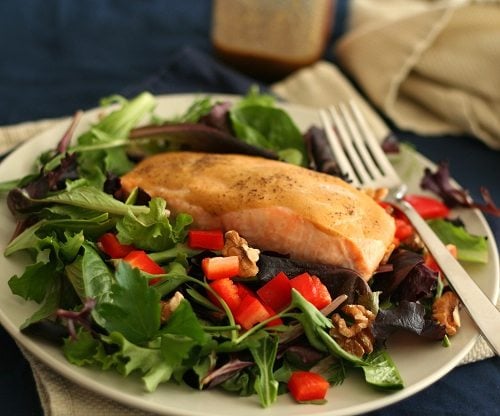
Maple-Glazed Salmon Salad with Walnut Oil Vinaegrette


Maple Glazed Salmon Salad Recipe
Yield: 4 servings
A heart healthy salad, full of Omega 3s and satisfying enough to be the full dinner.
Ingredients
    Walnut Oil Vinaigrette:
  • ¼ cup walnut oil
  • ¼ cup apple cider vinegar
  • 1 tbsp balsamic vinegar
  • 1 tbsp Dijon mustard
  • 1 garlic clove, minced
  • ½ tsp dried oregano
  • ½ tsp salt
  • ¼ tsp pepper
  • Salad:
  • 1 tbsp olive oil
  • 2 tbsp sugar-free maple syrup (I used Nature's Hollow) OR 2 tbsp real maple syrup
  • 1 tbsp Dijon mustard
  • ½ tsp maple extract (omit if using maple syrup)
  • 1 lb salmon filet
  • Salt and pepper
  • 6 cups salad greens, spinach or a combination
  • 2 red peppers, chopped
  • 1 cup walnuts, lightly toasted
Instructions
  1. For Walnut Oil Vinaigrette, whisk all ingredients together and set aside.
  2. For the salad, preheat oven to 425F and brush a large glass or ceramic baking dish with olive oil.
  3. In a small bowl, whisk together Dijon mustard, maple syrup and maple extract.
  4. Cut filet into 4 even portions and arrange in baking dish. Sprinkle with salt and pepper and brush with glaze.
  5. Bake 9 to 11 minutes, until fish is cooked through and flakes easily with a fork. Remove and let cool 10 minutes.
  6. Divide salad greens between 4 large plates.
  7. Sprinkle each with chopped red peppers and walnuts.
  8. Top each with a salmon portion.
  9. Pass dressing at table.
Notes
Serves 4. Each serving has 11 g total carbs and 5 g of fiber. Total NET CARBS = 6g (If using sugar-free maple syrup).

Banana Berry Protein Smoothie


  • 1C Unsweetened Almond Milk
  • 1/2C plain Greek yogurt
  • 2 TBspn chia seeds
  • 1 frozen banana
  • 1/2C blueberries
  • 1 scoop vanilla Whey "Anytime Protein" (http://www.shopabouttime.com/?Click=6817)      powder
  • Handful of ice cubes
Macros
  • Cals: 456
  • Protein: 38g
  • Carbs: 54g
  • Fat: 13g
  • Fiber: 12g

2012 Sports Illustrated Kids SportsKids of the Year, brothers Conner and Cayden Long

Great Tip for KB/DB Deadlifting


Tuesday, February 12, 2013

Health Club Consumer Report


I just came across the 2012 Health Club Consumer Report from the International Health & Racquet Sportclub Association (IHRSA).  They are as follows:

  • Members visited fitness facilities an average of 102.5 times in 2011.
  • Consumers paid an average of $42.55 in monthly membership fees
  • 6.4 million Americans used personal training in 2011
  • Those members who visited their club at least 100 days per year were...
    • more likely to be male than female
    • about 42.9 years old
    • had at least a college degree
    • had been a member for an average of 5.4 years 

Saturday, February 02, 2013

How Many Pull-ups Does It Take To Make A Female Marine?


With the recent announcement of women being allowed in full combat in the U.S. Armed Forces, I was curious about specific physical fitness testing.  The New York Times ran a good article in today's paper about this very topic.  Check it out here: http://www.nytimes.com/2013/02/02/us/politics/first-pull-ups-then-combat-marines-say.html

Wednesday, January 02, 2013

Today's "Moment of Zen"

Certain things really make me happy, one in particularly receiving funny emails from certain people.  Without fail, I got this cute email from one of my friends today who teaches spinning at my gym:
--------------------------------------------------------------------------------------------------------------------------
So, I walked into gym last night to teach my spin class and was looking to kick off 2013 with a little PC Conditioning motivation?? What?? Nothing?? I didn't know what to do? Then I thought...mmmmm how very zen of Paul... The message was to take time for some self-reflection, the answers are within yourself.... i get it! Very powerful ....nice job...☺!
Heehee Happy New Year!


Tuesday, January 01, 2013

Coaching Anti-Extension Core Stability


Coach Greg Robins did an outstanding job with this video on teaching Anti-Extension.

Sunday, December 23, 2012

Tuesday, December 18, 2012

How Yoga Can Wreck Your Body


Good article from the New York Times to check out: http://www.nytimes.com/2012/01/08/magazine/how-yoga-can-wreck-your-body.html?_r=3&nl=todaysheadlines&emc=tha210&pagewanted=all&

Protein Banana Walnut Bars


I ate the whole thing in just a few days...
Ingredients:
1/2 cup rolled oats
6 scoops vanilla protein powder (3 scoops unsweetened, 3 scoops sweetened)
2 cups walnut meal (grind the walnuts in a blender…that’s it!)
1/4 tsp baking powder
pinch salt

2 medium bananas (very soft, mashed)* I used frozen, thawed over-ripe bananas from my freezer
2 large Omega-3 eggs
2 Tbsp pasture butter
2 Tbsp water as needed

Directions:
Mix the dry ingredients together in one bowl and the wet ingredients in another. Then mix the two bowls together. If needed, add a tbsp or two of water to mix well.

Heat oven to 350F. Place ingredients in a metal 7 x 11 non-stick baking pan and bake at 350F for 12 mins until a knife comes out clean from the SIDES of the pan (not the middle). It should be slightly undercooked in the middle when you first take it out. If you bake this too long it will be very dry.
Makes 15 small bars ** I have horrible cutting skills as noted by the picture above...
Nutrition Facts: 190 calories, 12 g protein, 8 g carbs, 1.7 g fiber, 12 g fat, 2 g saturated fat, 1.5 g omega-3 poly fat, 6 g omega-6 poly fat, 33 mg cholesterol, 33 mg sodium

Brian Regan- Hilarious Nutrition Standup

Julie Foucher


Friday, December 14, 2012

Fat Loss Tips from Precision Nutrition


5 Questions for Fat Loss
Most people have heard about how to eat for fat loss. But
they just can’t figure out what to eat when it comes time for a meal. And that’s largely because they’re asking themselves the wrong questions.

That’s why we created this simple cheat sheet. It helps you ask the right questions at the most critical time – when it’s time to pick up the fork and spoon. To get the most out of this cheat sheet, simply print it out, fold it up, and make sure to ask yourself the following questions before your next meal.
Q1. Are you eating too much food?
When fat loss is your primary goal, you should stop eating when you’re about 80% full. This will leave you satiated but not belly-rubbing full. So, for this next meal, do you plan on eating a little less than you normally would?
You can eat from a smaller plate than usual. You can leave a little on the plate, instead of finishing everything in front of you. Or you can stop at one serving instead of going back for seconds. Whatever strategy you use, make sure you’re decreasing your calories compared to what you might normally eat.
Q2. Are you eating enough protein?
Your protein intake determines whether you’re going to lose body fat or lean muscle. (Obviously, we want to lose the first and keep the latter.) So, for this next meal, is there enough lean protein included? Men should eat about 2 palm-sized portions and women should eat about 1 palm-sized portion.
You can choose from sources including: lean meats (chicken, turkey, fish, lean beef, lean game meats), lean vegetarian sources (tofu, tempeh, legumes), or powdered protein supplements. Whichever type you choose, make sure you’re eating more protein than what you might normally eat.
Q3. Are you eating too many sugars or starches?
Too many starches and sugars in your diet can prevent fat loss (or even cause fat gain). So, for
this next meal, are there too many starches, particularly processed ones like bread or pasta? Men should eat less than 1 fist-sized portion and women should eat less than 1⁄2 fist-sized portion. Also, the amount of sugar should be minimized.

Starches in the diet include grains, pasta, potatoes, rice, bread, and other carb-dense foods. And added sugars can be found in pop/soda, fruit juices, salad dressings, desserts, sweet snacks, and more. Again, you don’t have to cut these out completely. You just have to be sure to eat fewer of them than usual.
Copyright © 2011 by Precision Nutrition Inc.
Q4. Are you eating enough vegetables?
By replacing your grains with greens, you’ll still feel satisfied at the end of a meal while also increasing your intake of fiber and other important vitamins/minerals. So, for this next meal, are you eating enough vegetables? For fat loss, men should eat about 1 cup while women should eat about 1⁄2 cup.
While most people think of salads when veggies are brought up, many other options are available. Baked, grilled, sautéed, or steamed veggies all count. As do foods like pesto or even kale chips. Regardless of which veggies you choose, make sure you’re eating more than usual.
Q5. Are you including enough healthy fats?
Highly processed fats, often found in processed foods, can ruin your health and lead to fat gain. However, a healthy mix of other naturally occurring fats is important for fat loss. So, for this next meal, are you eating some healthy fats?
You can choose from sources like olive oil, avocados, raw nuts (not roasted), raw seeds, and omega-3 rich fish oils. Whichever type you choose, make sure you’re adding healthy fats to your diet while replacing the unhealthy ones.
Copyright © 2011 by Precision Nutrition Inc. 

My New Affiliate Nutrition Company


Click HERE: About Time Nutrition Products

How to Foam Roll the IT Band

Wednesday, December 05, 2012

Wednesday, November 28, 2012

3 Exercise Training Circuit


  • KB Goblet Squat
  • KB Swing
  • MB Slams

Tuesday, November 27, 2012

Saturday, November 17, 2012

"Call Me Maybe" Tempo Controlled by Heart Rate


One of my research projects in college was to analyze physiological responses to varying genres of music.  One area I didn't focus on, however, was manipulating heart rate and music  tempo simultaneously.  Pretty cool stuff here!

Sunday, November 11, 2012

100+ Facts about 25 Well-Known Foods


Did you know...


  • Asparagus is a good source of vitamins A, C and E, B-complex vitamins, potassium and zinc
  • An avocado has more than twice as much potassium as a banana.
  • Broccoli contains twice the vitamin C of an orange
  • Onions are a rich source of quercetin, a potent antioxidant.
  • Kale eases lung congestion and is beneficial to the stomach, liver and immune system
Al the above....and much more...can be found at the following: http://www.mercola.com/nutritionplan/foodalert.htm

Sunday, November 04, 2012

Study Shows Fast FOod Leaves You Depressed


A new study in the journal Public Health Nutrition showed people who frequent drive-thrus and load their shopping cart with Entenmann’s and Twinkies suffer more depression.

Check out the following for more info: http://jonnybowdenblog.com/fast-food-depression/

Saturday, October 20, 2012

Friday, October 19, 2012

"Why getting physically stronger will help you live longer"


I wanted to share a great article that was forwarded to me from my friend, Coach Vic Brown, of Boston University (http://www.goterriers.com/genrel/brown_vic00.html).  The article discusses the power of strength training and is well-written.  You can check it our here: http://io9.com/5953154/why-getting-physically-stronger-will-help-you-to-live-longer

OK, I'll admit I have a crush on the reigning Crossfit Games Champion, Annie Thorisdottir- AKA The Fittest Female in the World!

Tuesday, October 09, 2012

Better Every Year


Really loving this new article from Alli McKee, as I think along the same lines as her (always seeking self-improvement in all facets of life).  Check it out by clicking here: http://allimckee.com/uncategorized/better-every-year

Friday, September 21, 2012

Adductor Rolling


Deadlifting and Squatting produces a fair amount of adductor tightness in my legs.  If you're in the same camp, consider implementing foam rolling of the affected area.  See video above for specifics.

Thursday, September 20, 2012

Fantastic Quote from Nutritionist Mike Roussell


"Being lean is not normal in today's society. This means you need to do things that normal people don't do. You need to pack your own lunch; you need to request food be prepared differently than what's listed on most menus; your idea of 'fast food' should be a protein shake; and you can't take the weekend off from your diet like you do your job."

Wednesday, September 05, 2012

Trap Bar Deadlift Quad Dominance


My favorite lower body bilateral exercise remains the Trap/Hex Bar Deadlift.  Check out Coach Greg Robins here discuss how to avoid "Quad Dominance" in this exercise.

Monday, August 27, 2012

9 Ingredients to Add to Your Super Shakes!


Nutritionist Chris Mohr submitted the following list.  I use 7 of them regularly.  Let me know what you put in your Super Shakes!


  1.  Raw cocoa powder.  There is no sugar added, just a rich, dark chocolate taste that is loaded with antioxidants.  Try 1 – 2 TBS in your next smoothie.
  2. Spinach.  Yes, spinach — in its leafy green goodness form.  No, it won’t give your smoothie a gross flavor (but adding blueberries, too, will make the color more appealing).  We often add 2-3 large handfuls of raw spinach to our shake and blend to oblivion.  It’s loaded with fiber, iron, and other powerful vitamins and minerals and what a simple way to add more leafy greens to your diet.  Give it a whirl! 
  3. Walnuts.  We love nuts and have touted the benefits of these and other nuts.  But these guys in particular add a nice flavor (and nutrient boost) to the shakes.  Walnuts will help fill you up, with all their quality fat, protein and fiber.  Of course they’re also high in a vitamins and minerals, to boot, and give the shake just a different flavor than traditional nut butters.
  4. Pomegranate seeds.  While it’s a tedious job to extract each seed one by one, several stores now carry these seeds in a small container — no messy work at all — nothing but the beneficial seeds.
  5. Chia seeds.  While we’re on the ‘seed theme’ — let’s continue with these little sesame seed looking little guys that pack a powerful punch.  High in fiber.  High in protein.  Hight in omega-3 fats. Just be careful — blend and drink soon after, as these little guys make any liquid pretty gelatinous in just a short time.
  6. Kefir.  Ever hear of it? If you haven’t tried it, you should.  It’s a drinkable yogurt that’s high in calcium and healthy probiotics (food for your gut) that have been shown to boost immunity. 
  7. Green tea.  You can make a cup than use that as the liquid (blended with ice, it will cool it down immediately).  But the antioxidants in tea are well worth it and may have powerful effects like protecting your skin from sun damage, reducing your risk of heart disease and maybe even burning a little belly fat. 
  8. Black coffee.  It’s high in antioxidants.  You’ll get a little caffeine boost.  And if you like the flavor, it could be a nice shake that is loaded with nutrients.  I wouldn’t necessary mix it with green tea, but here’s another alternative as a liquid base.  Use a chocolate protein powder and, voila, you’ve got a mocha shake.  Awesome!
  9. Fresh ginger. You’ll find ginger root in the produce aisle of your grocery store.  Grate about 1 TBS (it has some heat, so don’t go overboard) for a nice kick to your dish.  But the antimicrobial and immune boosting properties make this one well worth it!

Wednesday, August 22, 2012

Stick to the Basics


I'm constantly the "K.I.S.S." Principle to my clients.  The simple stuff will ALWAYS win in the end.  My colleague, Tony Gentilcore, recently wrote a post on this very topic.  He summarized keeping it simple better than I could, so I wanted to share his sentiments:

- Focus on compound movements that force you to integrate the entire body: squat, deadlift, chin-ups, bench press, military press, lunge variation, row, etc.
- For the love of god, step away from the Smith machine.
- And would it kill you to wash your gyms shorts on occasion?
- Stress QUALITY over quantity. I’d rather someone go to the gym and perform 5×5 deadlifts (making sure technique is solid on each rep) than spend an hour doing god-knows-what.
- 3x per week, full-body, is a solid approach for most people.
- Throw in a day (or two) of interval based training and you’re golden.
- Please don’t skip your soft tissue or mobility work.
- Walking shouldn’t be considered exercise.  It’s called life.
- How much weight should you use?  If you can easily hit all your reps, bump the weight up 5-10 lbs.  It’s not rocket science.  And no, you won’t get big a bulky.  Stop thinking you’re going to turn into Arnold Schwarzenegger in a week.
- Just to mix it up a bit, save “bench day” for any day other than Monday. Trust me, the world won’t end.
- Training sessions should be no longer than 45-60 minutes (75 minutes, tops if you include SportsCenter highlight breaks).
- The bulk of your exercises should be barbell and dumbbell based.
- If you can’t perform at least five bodyweight chin-ups (man or woman), you have no business performing 46 sets of bicep curls.
- Do some push-ups (or TRX rows) instead.
- Find a good training partner.  It makes all the difference in the world.
- Less is more.  Try to limit yourself to 3-5 exercises per session.
- Don’t be intimidated to ask for help or to be coached.  Even the best in the business ask for help from time to time.